

This article has been written with the support of artificial intelligence and reviewed by the Vedrai team, which manages the content in the Resources section of the website.
Only 18% of large Italian companies take a Decision Intelligence approach, according to the Data & Decision Intelligence Observatory of Politecnico di Milano (2026). Yet Italian spending on Data Management & Analytics has reached €5.07 billion, up 24% on 2025. The problem is not a lack of data: it is the step from data to choice.
This guide compares the main Decision Intelligence platforms on the Italian market, explains how to approach Palantir alternatives and proposes seven verifiable criteria for choosing. It is not a ranking: it is a comparison method built on public sources, checked on 25 November 2026.
In short. A Decision Intelligence platform is software that helps you decide, not just see: it combines data, models, simulation and artificial intelligence to compare alternatives and estimate their economic impact before acting. Gartner recognised the category with its first dedicated Magic Quadrant, published in January 2026. The market mixes international vendors (Palantir, Aera Technology, o9 Solutions), planning specialists (Board) and Italian players (Rulex, WhAI, CRIF). The choice depends on the decision you want to govern, not on a league table.
What is a Decision Intelligence platform?
A Decision Intelligence platform (DIP) is software for building decision-centric solutions: it supports, augments and, where appropriate, executes decisions made by people or systems, powered by data, analytics, knowledge and AI. This is the definition Gartner uses in the first Magic Quadrant dedicated to the category, published on 26 January 2026.
In practice, such a platform rests on four elements:
- Decision model: objectives, the levers you can act on, constraints and the criteria the company uses to choose.
- Internal and external data: ERP, CRM, files and market sources such as prices, rates, energy and demand.
- Simulation and optimisation: comparison of alternatives and an estimate of the economic impact of each.
- Tracking and human oversight: every choice recorded with the assumptions behind it and the agreed level of autonomy.
The practical test is simple: after using it, do you know which alternative to choose and what it costs not to choose? If the answer is one more chart, it is still reporting.
The Italian picture explains why the question is open. According to the Politecnico di Milano Observatory, large companies account for 75% of the market and only 18% of them take a Decision Intelligence approach. For SMEs the path is further in the background, but also easier to start, because it begins with a single decision.
What are the main Decision Intelligence platforms in Italy?
There is no single ranking. The 2026 Gartner Magic Quadrant lists 17 vendors, including Aera Technology, o9 Solutions, Rulex and the Italian CRIF. Outside that list, other solutions relevant to decision makers operate, such as Palantir, Board and WhAI. The table compares six platforms on verifiable elements, in alphabetical order.
- Aera Technology. Origin: Mountain View, California (USA). Stated focus: Aera Decision Cloud, an "agentic" platform for decisions in business processes. Gartner MQ Decision Intelligence 2026: Included; Leader according to the vendor's own communication.
- Board International. Origin: Chiasso (Switzerland), founded 1994, also based in Boston. Stated focus: Planning and performance management; Board Agentic Planning Platform; external economic data via Prevedere (acquired 2024). Gartner MQ Decision Intelligence 2026: Not in the vendor list; Leader in the 2024 Financial Planning Software MQ according to Board.
- o9 Solutions. Origin: Dallas (USA), founded 2009. Stated focus: Integrated planning, "Digital Brain" on an Enterprise Knowledge Graph, scenario planning and simulation. Gartner MQ Decision Intelligence 2026: Included.
- Palantir. Origin: USA, founded 2003. Stated focus: Foundry and AIP; an ontology that represents the enterprise's data and decisions. Gartner MQ Decision Intelligence 2026: Not in the vendor list.
- Rulex. Origin: Genoa (Italy), also based in Boston. Stated focus: Rulex Platform: explainable AI, what-if simulators, mathematical optimisation, no-code. Gartner MQ Decision Intelligence 2026: Included as a Niche Player.
- Vedrai. Origin: Milan (Italy), active since 2020. Stated focus: WhAI: a calculation model of how the company decides; scenario simulation, probability of reaching the objective, outcome tracking. Gartner MQ Decision Intelligence 2026: Not included.
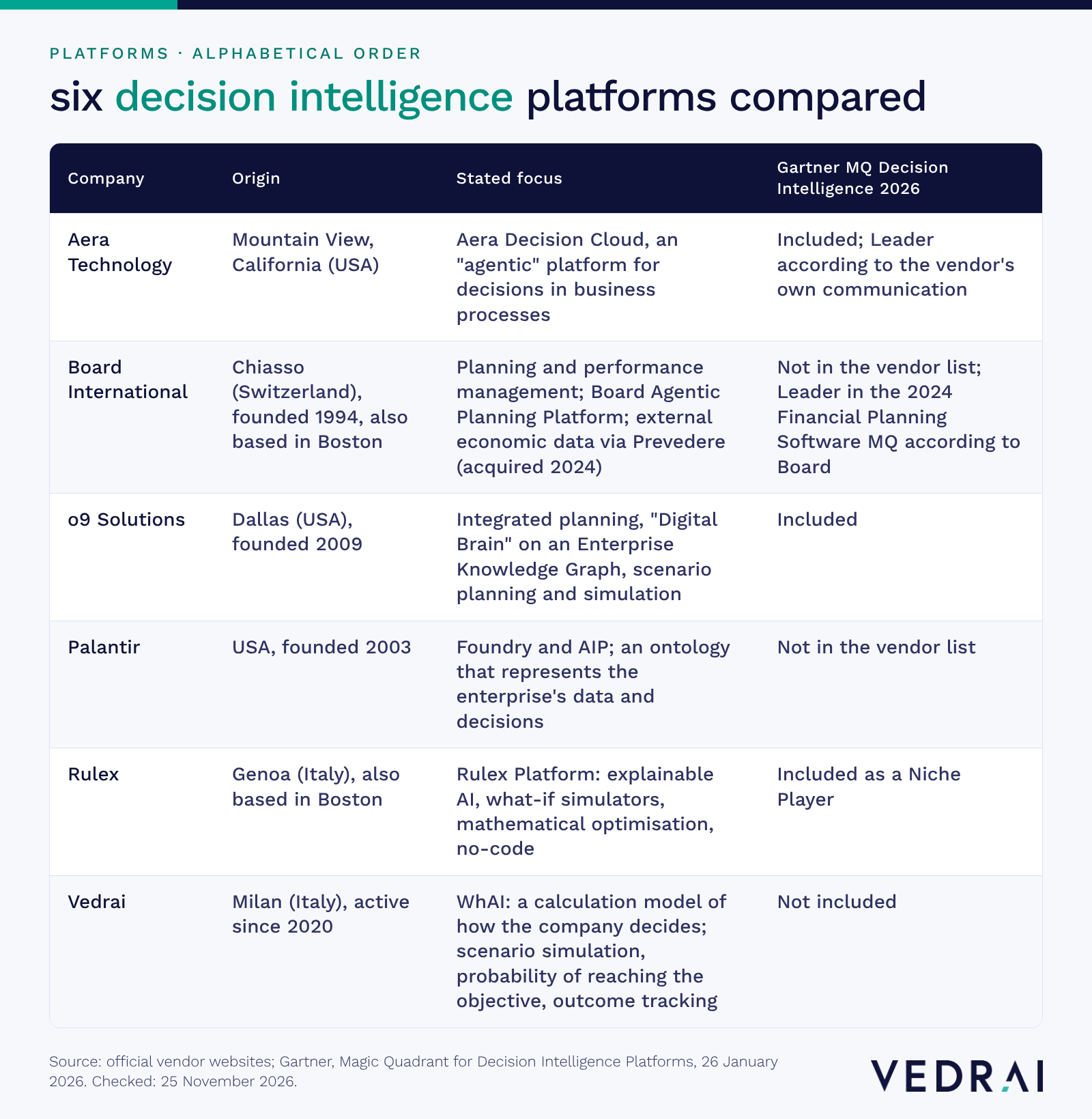
Three cautions when reading the table. First, the vendors are not homogeneous: Board comes from planning, Rulex from explainable AI, Palantir from large-scale data integration. Second, being in the Magic Quadrant reflects an analyst's judgement on set criteria, not fit for a specific case. Third, other Italian players are on the Gartner list too, such as CRIF, with an offer aimed at financial services. The comparison only works if it starts from a concrete decision.
What are the alternatives to Palantir?
The alternatives to Palantir depend on what you want to replace: a general-purpose data platform at scale, or a tool focused on specific decisions such as purchasing, pricing, production and finance. Palantir, founded in 2003, offers Foundry and AIP and builds an ontology that describes the enterprise through its data and decisions. No other vendor replicates it point for point.
Three situations can be distinguished:
- You need a data foundation and a model of the whole organisation. Compare data-integration platforms and ontologies, weighing time, internal skills and vendor dependency.
- You need to decide better on a specific process (offer price, purchasing plan, production mix). Look at specialised Decision Intelligence platforms such as WhAI, Rulex, Aera Technology or o9 Solutions.
- You need to improve budget and forecast. Evaluate planning suites such as Board, possibly alongside a calculation layer that estimates probabilities.
Before choosing, four questions help compare different solutions: how long from project to first result, where model and data reside, which skills are needed in-house, and what happens if you change supplier.
How does Decision Intelligence differ from BI and generative AI?
Business intelligence describes what happened, generative AI writes answers, Decision Intelligence establishes what is best to decide now and with what consequences. They are different layers of the same process: one does not replace the other.
- Business intelligence. Question it answers: What happened? Limit if used alone to decide: Does not compare future alternatives.
- Planning and FP&A. Question it answers: What is the plan? Limit if used alone to decide: One value per line, no probability.
- Generative AI (LLM). Question it answers: How can it be explained or summarised? Limit if used alone to decide: The answer can change with how the question is phrased.
- Decision Intelligence. Question it answers: Which alternative is best, and with what probability of hitting the objective? Limit if used alone to decide: Requires a decision model and reliable data.

The difference shows in the calculation. In a deterministic approach, the same data and assumptions produce the same result; generative AI interprets the question and explains the outcome, but should not do the maths in place of the model. That is why the most solid combination uses generative AI as the interface and a calculation engine as the source of the numbers.
What is agentic Decision Intelligence?
Agentic Decision Intelligence is the use of AI agents that, inside a process, call a decision platform when a number that moves an objective is needed, such as a reorder quantity or a price, and continue with a calculated, explainable result or hand it to a person. The agent handles the steps, the model handles the calculation.
The topic is both relevant and risky. Gartner predicts that over 40% of agentic AI projects will be cancelled by the end of 2027, because of costs, unclear value and inadequate risk controls. Most likely, the projects that hold up are those where the decision perimeter is explicit, the calculation is verifiable and each decision has an agreed level of oversight. The MCP protocol, introduced by Anthropic in 2024 and now under the Linux Foundation, is one way an agent can call an external tool of this kind; the deeper dive is in the dedicated article on LLMs and Agentic Decision Intelligence. The piece that holds architecture and calculation together is the decision layer: the part of the system that turns data into a choice, estimating what is not observed, simulating the alternatives and ranking them against an objective. The research "To run a company with AI, do you need the strongest model?" tests it on YC-Bench and indicates that, in the test, it weighed more than the choice of language model (a study run by Vedrai, as a preprint).
Which software simulates business decisions?
To simulate a decision you need software that calculates several alternatives on the same data, estimates their probability of success and respects company constraints such as cash, inventory or capacity. Spreadsheets and dashboards can host a scenario, but they do not keep it up to date or track the choice. The terms to search for are what-if analysis, scenario planning and prescriptive analytics.
A manufacturing example makes the point. The question "at what price should we sign this offer, given today's costs?" requires updating material and labour costs, comparing price and discount with the probability of winning the tender, and respecting a minimum margin agreed with Finance. A report shows yesterday's margin; a simulation shows tomorrow's trade-off.
Good simulation software, in short, should:
- calculate several alternatives in the same model, with explicit, editable assumptions;
- indicate the probability of reaching the objective, not a single value;
- bring in external factors such as raw materials, energy, rates and demand;
- work within cash, inventory and capacity constraints;
- record assumptions and outcome, so the next decision starts from what was learned.
How do you choose a Decision Intelligence platform?
You choose starting from a recurring decision that weighs on margin, not from the vendor's catalogue, and by assessing seven criteria that can be verified during a trial.
- Starting decision. Which choice, by whom and toward what objective? If it cannot be said in one sentence, the project is premature.
- Integration. Does it connect to existing ERP, CRM, MES and spreadsheets without replacing them?
- Time to first value. Can you start with a trial on a real case, even with manual data exchange, before full integration?
- Scenario modelling. Can models be customised to the company's logic, or are they generic?
- External factors. Do prices, energy, rates, exchange rates and demand enter the calculation?
- Governance. Are there autonomy levels per decision, assumption tracking and human oversight?
- Data, security and cost model. Where do model and data reside, who owns the model, how is the cost made up (set-up, subscription, support)?
The most honest yardstick remains the real use case. Ask each supplier to show the same decision, with the same data, and compare how alternatives, assumptions and risk are presented.
Where does WhAI fit in Decision Intelligence?
Vedrai is an Italian tech company specialising in Decision Intelligence. Through WhAI, it enables companies to simulate alternative scenarios, optimise strategic and operational decisions and assess their economic impact, combining data, mathematical models and generative artificial intelligence.
In practice, WhAI turns how the company decides into a calculation model: it estimates the probability of reaching the objective for each alternative, ranks them and records the outcome. It comprises WhAIQ, the calculation engine; WhAI Decide, where objectives, processes and decision history are defined; and WhAI External, which brings rates, energy, raw materials, exchange rates and demand into the calculation. Autonomy is set decision by decision: WhAI can recommend and leave the choice to a person, prepare the choice for confirmation, or act within rules set by the company. Model and data are hosted on servers in Europe and the model remains the customer's.
Vedrai works with Private Equity and Italian SMEs, mainly in manufacturing and retail, and always starts from a decision. Typical cases are purchasing and hedging, offer price and discounts and management control. To see where to begin, you can use AI Navigator, the free assessment that produces an AI Value Map.
Request a demo · Discover WhAI
Key takeaways
- Only 18% of large Italian companies take a Decision Intelligence approach; the Data Management & Analytics market is worth €5.07 billion (Politecnico di Milano, 2026).
- Gartner published the first Magic Quadrant for Decision Intelligence platforms in January 2026: the category is official, but vendors are not homogeneous.
- Palantir alternatives depend on the decision to govern: data foundation and ontology, specific decisions, or planning.
- BI describes, generative AI explains, Decision Intelligence calculates and compares alternatives; the solid combination uses generative AI as the interface and a calculation engine for the numbers.
- Choose by trialling the same decision with the same data, assessing integration, governance, security and time to first value.
Frequently asked questions
What is a Decision Intelligence platform in simple terms?
A Decision Intelligence platform is software that helps a company choose between alternatives, not just read data: it combines internal and external data, mathematical models and artificial intelligence to simulate scenarios, estimate the economic impact of each option and keep a record of the decision taken. It serves those who must decide on prices, purchasing, production or budgets.
What are the alternatives to Palantir in Italy?
There is no single answer, because it depends on what you want to replace. For decisions on purchasing, pricing, production and finance, specialised platforms such as WhAI, Rulex, Aera Technology or o9 Solutions are evaluated, while for planning and management control, suites such as Board are considered. The comparison should be made on the same decision, with the same data.
What is the difference between Decision Intelligence and business intelligence?
Business intelligence describes what happened, while Decision Intelligence helps establish what is best to do now and with what consequences. The first reads historical data in reports and dashboards; the second simulates alternatives, estimates their impact on objectives and records the choice. The two coexist in the same process.
Does a Decision Intelligence platform replace ERP and planning tools?
No: a Decision Intelligence platform sits on top of existing systems such as ERP, CRM, planning tools and BI, which keep supplying data and hosting the plan. It adds the calculation of alternatives and the tracking of choices, without requiring you to replace the systems in use.
How long does it take to get the first supported decisions?
It depends on data availability and quality, but the most prudent approach starts from a single recurring decision. The model is built on that case, often with an initial manual data exchange, and only afterwards integrated with ERP, MES or CRM, so value is measured before the perimeter is extended.
Does Decision Intelligence make sense for an SME?
Yes, if the decision is frequent and weighs on margin, such as purchasing, offers or production. The Politecnico di Milano Observatory indicates that large companies hold 75% of the market: SMEs are still little represented and can start from a single use case, using data they already have.


