

Procurement

Decide when to buy, how much and how to hedge on raw materials and energy.

Raw material and energy prices cannot be controlled, but they can be estimated in various scenarios and translated into profit margins. WhAI compares purchase plans, hedges, and spot prices, and determines the best decision, in euros.

Lower average purchase cost on all raw materials

Less margin exposed to raw material price swings

Less cash tied up in inventory and safety stock

WhAI comparing steel and energy purchase plans with hedging and spot
THE PROBLEM

Purchases are made in a hurry, not on a forecast: the risk lands on margin.

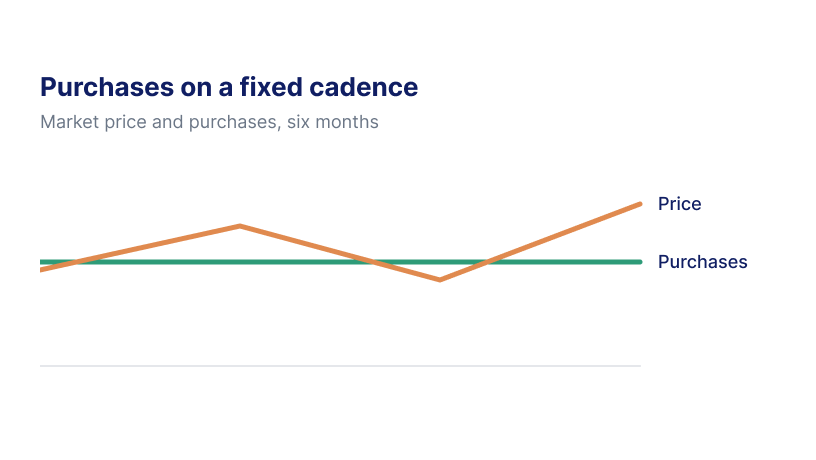
Market price moving while purchases follow a fixed six-month cadence

Purchases on a fixed cadence

You buy on a fixed cadence or on price-rise announcements, tracking prices on sites and newsletters.
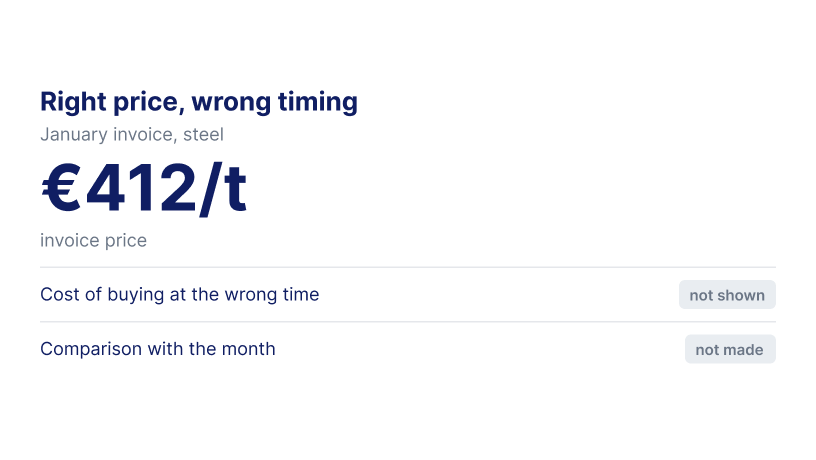
Steel invoice where the cost of buying at the wrong time does not show

Right price, wrong timing

The cost of buying at the wrong moment never shows on an invoice or in the actuals.
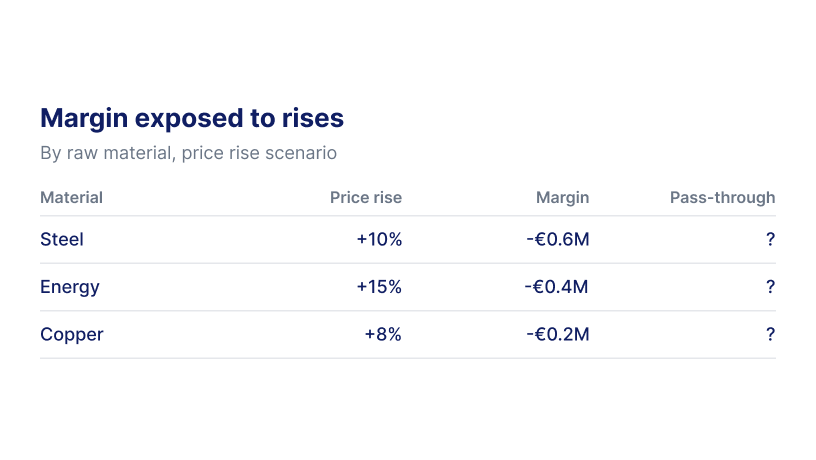
Margin impact of price rises by raw material, pass-through unknown

Margin exposed to rises

Price rises hit margin before price lists, and nobody knows how much can be passed on.

SOLUTIONS FOR 
Procurement

From market prices to hedging.

The function's recurring decisions, each with its own data and constraints.

PROCUREMENT

Price and cost scenarios

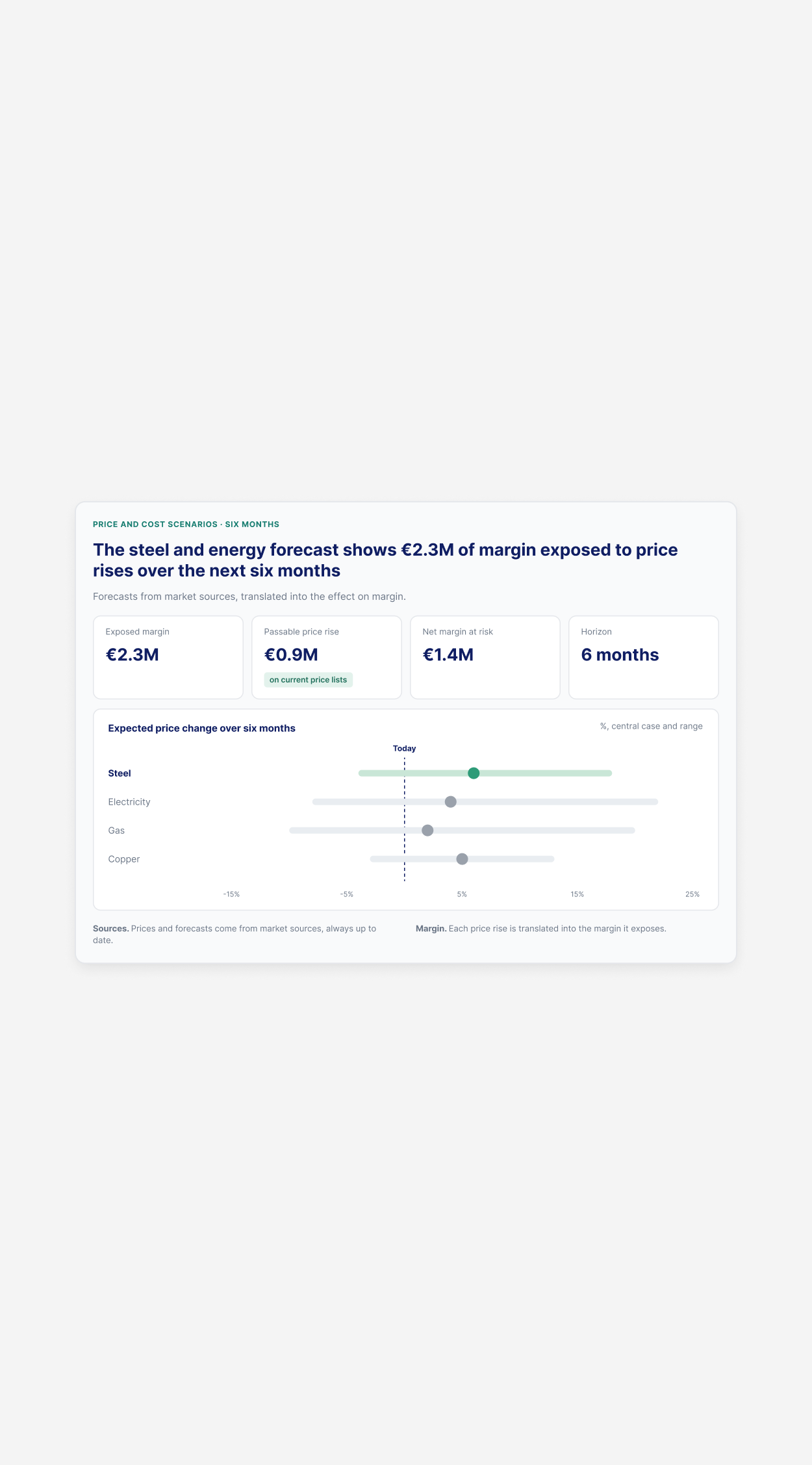
Forecasts on raw materials and energy from market sources, translated into margin exposed to rises.
  • Average purchase cost of raw materials
  • Margin exposed to price rises, measured
  • Share of price rises passed on to selling prices
WhAI steel and energy forecast translated into margin exposed to price rises
PROCUREMENT

Price and cost scenarios

Forecasts on raw materials and energy from market sources, translated into margin exposed to rises.

  • Average purchase cost of raw materials
  • Margin exposed to price rises, measured
  • Share of price rises passed on to selling prices
WhAI steel and energy forecast translated into margin exposed to price rises
PROCUREMENT

Supplier risk

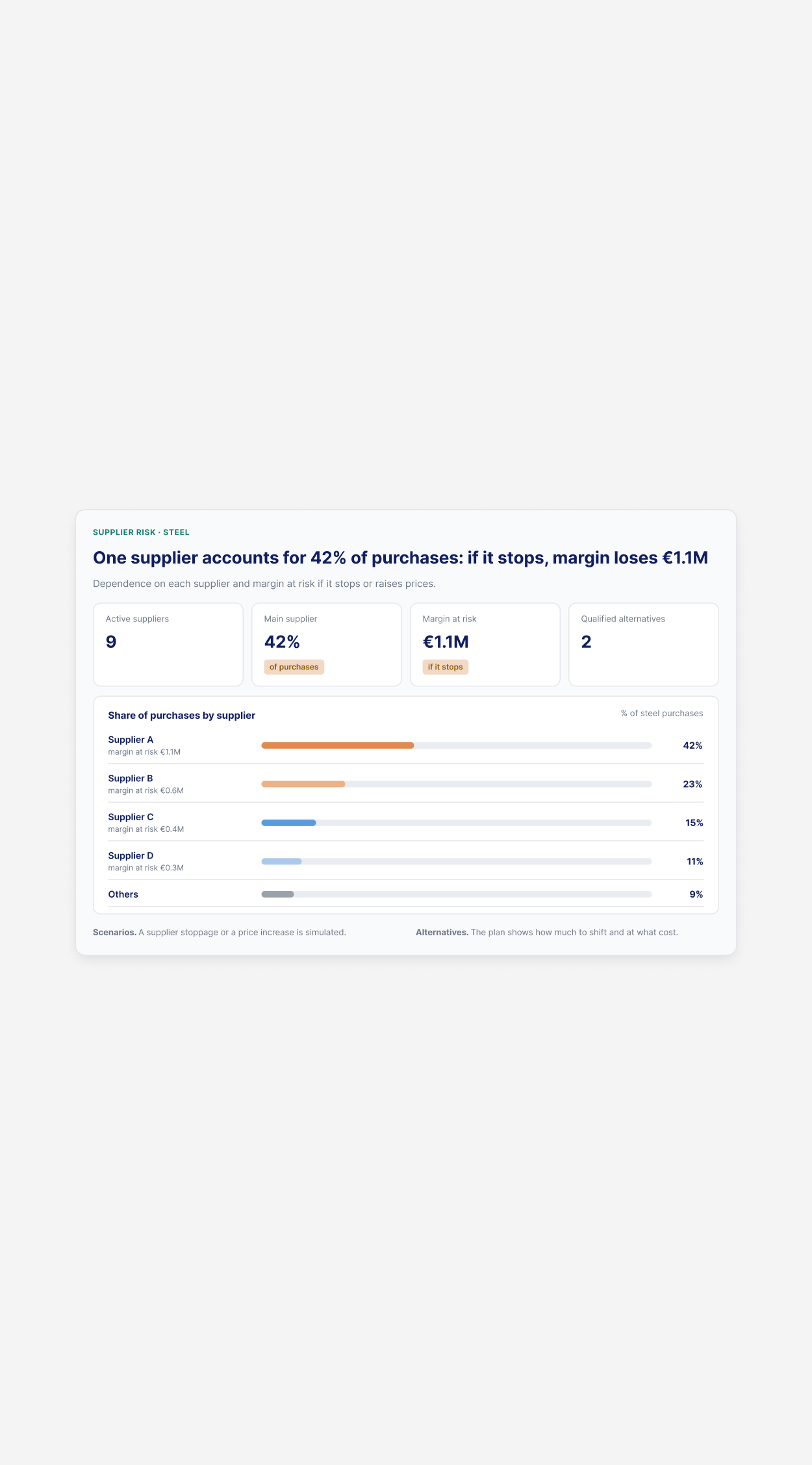
How much the company depends on each supplier, and what happens to margin if one stops or raises prices.
  • Dependency measured by supplier, area and category
  • Supply stoppages and delays avoided
  • Better terms in negotiation
WhAI share of purchases by supplier and margin at risk
PROCUREMENT

Price and cost scenarios

Forecasts on raw materials and energy from market sources, translated into margin exposed to rises.

  • Average purchase cost of raw materials
  • Margin exposed to price rises, measured
  • Share of price rises passed on to selling prices
WhAI steel and energy forecast translated into margin exposed to price rises
PROCUREMENT

Supplier risk

How much the company depends on each supplier, and what happens to margin if one stops or raises prices.

  • Dependency measured by supplier, area and category
  • Supply stoppages and delays avoided
  • Better terms in negotiation
WhAI share of purchases by supplier and margin at risk
PROCUREMENT

Hedging strategies

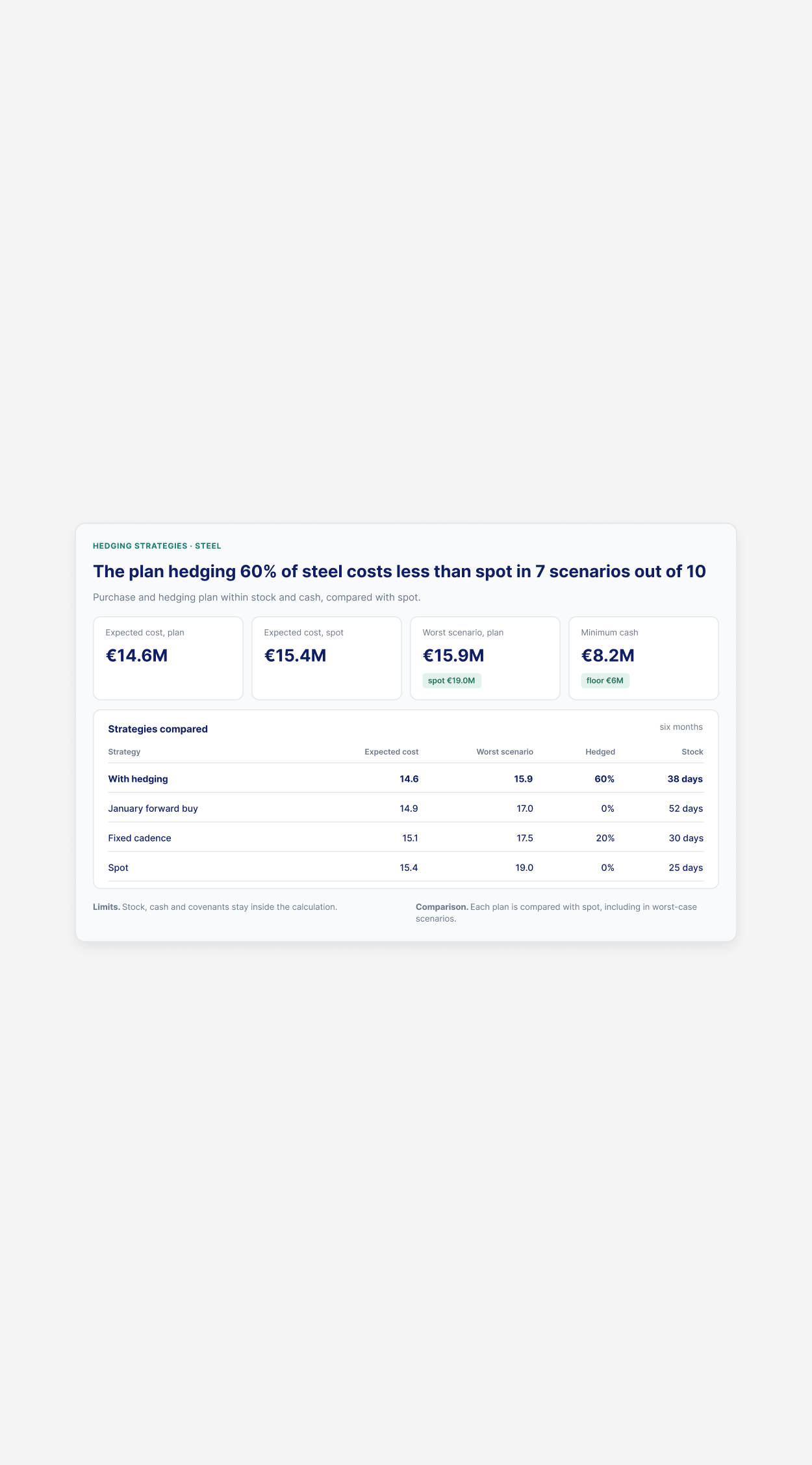
The most cost-effective purchasing and hedging plan, within stock and cash, compared with spot.
  • Price volatility exposure reduced
  • Hedges compared with spot, even in the worst case
  • Cash tied up in stock under control
WhAI hedging strategies compared with spot within stock and cash
PROCUREMENT

Price and cost scenarios

Forecasts on raw materials and energy from market sources, translated into margin exposed to rises.

  • Average purchase cost of raw materials
  • Margin exposed to price rises, measured
  • Share of price rises passed on to selling prices
WhAI steel and energy forecast translated into margin exposed to price rises
PROCUREMENT

Supplier risk

How much the company depends on each supplier, and what happens to margin if one stops or raises prices.

  • Dependency measured by supplier, area and category
  • Supply stoppages and delays avoided
  • Better terms in negotiation
WhAI share of purchases by supplier and margin at risk
PROCUREMENT

Hedging strategies

The most cost-effective purchasing and hedging plan, within stock and cash, compared with spot.

  • Price volatility exposure reduced
  • Hedges compared with spot, even in the worst case
  • Cash tied up in stock under control
WhAI hedging strategies compared with spot within stock and cash
A USE CASE

Raw material purchasing: buy at the right time, with less risk.

The decision
When, how much and how to hedge on raw materials.
What WhAI does
01
Forecasts raw materials and energy, from market sources
02
Measures exposed margin and how much of a rise is passed on
03
Purchase and hedging plan, within stock and cash limits
04
Compares with spot buying, including worst-case scenarios
What the annual return depends on
Average purchase cost of materials
Exposure to price volatility
Cash tied up in inventory
Starting data
Purchase lines, stock, consumption, market prices
Who it is for

Purchasing Management, Supply Chain, CFO

DECISION INTELLIGENCE

Decisions calculated on your numbers

WhAI: the missing layer for your decisions

WhAI turns the way your company decides into a calculation model. It simulates every choice before you act, estimates the probability of hitting the goal and tracks the outcome.

DISCOVER WHAI
Open purchasing decision in WhAI, with constraints checked and hedging compared with spot
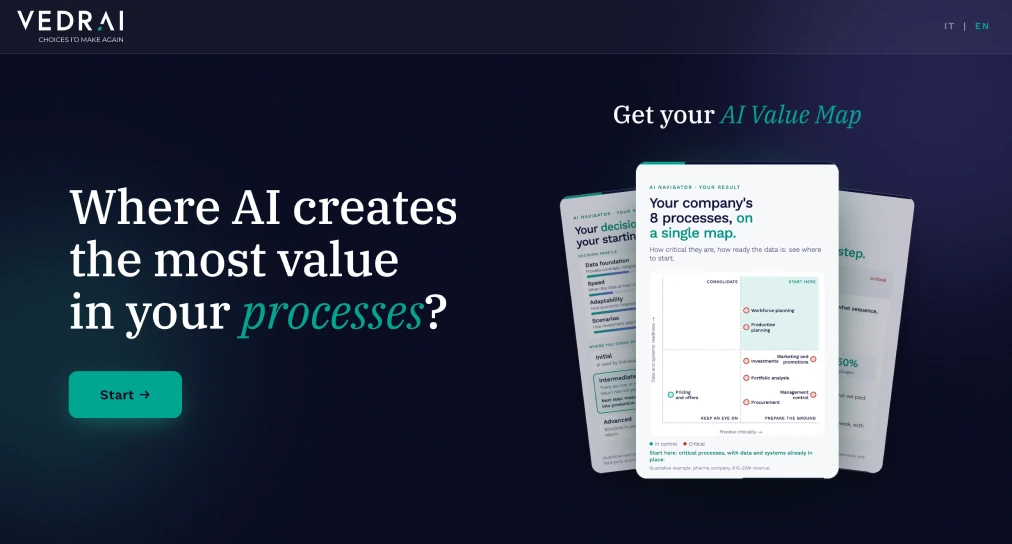
AI Navigator start page: where AI creates the most value in your processes, with a preview of the AI Value MapAI Navigator start page: where AI creates the most value in your processes, with a preview of the AI Value Map
AI NAVIGATOR

Which processes should you bring AI into?

AI Navigator is the assessment that identifies where AI creates the most value and which use case to start with: it cross-references data, process maturity, impact on margins and people, and returns your AI Value Map.

The highest-value use case
The KPIs to track
The estimated annual return

Request a demo

We’ll show you WhAI in action on a real process within your company