
The tools are the same for everyone. The extra margin goes to those who pick the right process to start with.
Nearly nine in ten companies already use AI, but only 6% get at least 5% of EBIT from it (McKinsey, 2026). The rest have the tools, not yet the margin. For companies that move with method, the opportunity is concrete: find the few processes where a repeated decision weighs on margin, cash and time, and where improvement can be measured from the start. That is where AI stops saving minutes and starts recovering margin.
Is AI in business now inevitable?
Yes, and the numbers leave little room to wait. According to McKinsey (The state of AI in 2026, 1,719 respondents in 97 countries, August 2026), nearly nine in ten respondents use AI regularly in at least one function, 44% are scaling it across the whole company (up from 38% in 2025) and 56% use it in three or more functions (51% a year earlier). 60% expect to increase investment next year. The 2026 directions of work are collected in the 10 AI trends in business.
Italy points the same way. Politecnico di Milano's Artificial Intelligence Observatory estimates the 2025 market at EUR 1.8 billion, up 50% on 2024. 71% of large companies have at least one AI project (59% in 2024) and 84% already hold generative AI licences.
AI has entered ordinary spending and ordinary work. A company that does not introduce it does not stand still: it falls behind on time, cost and quality against competitors, suppliers and customers who are already reviewing their processes.
How much work does AI save on a single task?
A lot, according to Anthropic's research. Across 100,000 real conversations with Claude, a task that would take about 90 minutes without AI is completed with a time reduction of around 80% (Estimating AI productivity gains from Claude conversations, November 2025). The Anthropic Economic Index of January 2026 shows that university-level tasks are done on average 12 times faster, and high-school-level tasks 9 times faster.
Adding up these gains, the authors estimate 1.8 percentage points of extra annual US labour productivity growth for ten years, stressing that this is not a forecast and that the estimate leaves out the time needed to check outputs. The same report estimates that Claude completes 67% of tasks successfully on Claude.ai and 49% through the API, with the rate falling as tasks get longer.
This advantage, however, is measured on the task, and a task is not a process: to become value for the company, saved time has to turn into a decision taken earlier, a cost avoided or a margin recovered.
Why isn't adopting AI enough to create value?
Because adoption measures how much AI is used, not how much it returns. In the same McKinsey research, 80% of respondents report better personal productivity, but only 37% attribute at least some positive EBIT impact to AI at company level. High performers, meaning companies that draw at least 5% of EBIT from AI with an impact they describe as significant, are about 6%, unchanged from 2025.
Between 80% and 6% sits the work still to be done on the process: people work better, but what surrounds them does not change. An analysis produced faster creates no margin if approval, accountability and data stay as they were. We explore this in AI creates value: a framework for Italian companies (Italian).
Why is it so hard to prove the return on investment?
Because most companies measure late, and little. According to Politecnico di Milano's Artificial Intelligence Observatory, 54% of large companies try to measure the benefit of generative AI, but only 11% monitor it periodically and in a structured way. About 1 company in 3 with AI projects struggles to estimate the cost-benefit ratio in advance, and only 9% of large companies have a structured AI governance.
Perception, meanwhile, runs ahead of the numbers. In 81,000 interviews collected by Anthropic in December 2025, 86% report gains in speed and 82% in the scope of their work, while cost savings are reported by 27% (self-reported). Speed is felt immediately. Cost savings, the figure a CFO must defend in front of the board, need a measure defined before starting.
The Italian case: large companies ahead, SMEs still waiting
The gap by company size is the sharpest Italian finding. 71% of large companies have an AI project, against 8% of SMEs (Artificial Intelligence Observatory, 2025 data). The 2025-2026 research of the Digital Innovation in SMEs Observatory adds that 76% of SMEs have neither invested nor plan to invest in AI, and that only 7% have started structured training programmes.
For an SME the risk is twofold: starting late and starting without a criterion. With limited budget and people, every wrong project weighs more. That is why choosing the first process is the most important decision, as discussed in AI and Italian SMEs (Italian).
Which processes should you start with to generate value?
Start with processes where a repeated decision affects margin or cash and where improvement can be measured. Four conditions let you rank the candidates:
- Impact on the key metric: the process weighs on margin, EBITDA, working capital or coverage, and its improvement is expressed as a percentage of that metric.
- Available, connected data: you know where the data sits, how it is connected and how much manual work it absorbs.
- A before-and-after measure: an indicator exists to compare the starting position with the result.
- An owner: someone has the authority to change the process, not just to try the tool.
A process with scattered data and a lot of manual work should not be discarded, but it needs preparing first. This is the field of Decision Intelligence, the category that puts data, models and decisions on the same footing and makes every choice traceable and comparable. The cost of inaction stays explicit: every week spent automating the wrong process, or touching none, has a price on margin.
How to find where AI creates the most value: the AI Navigator
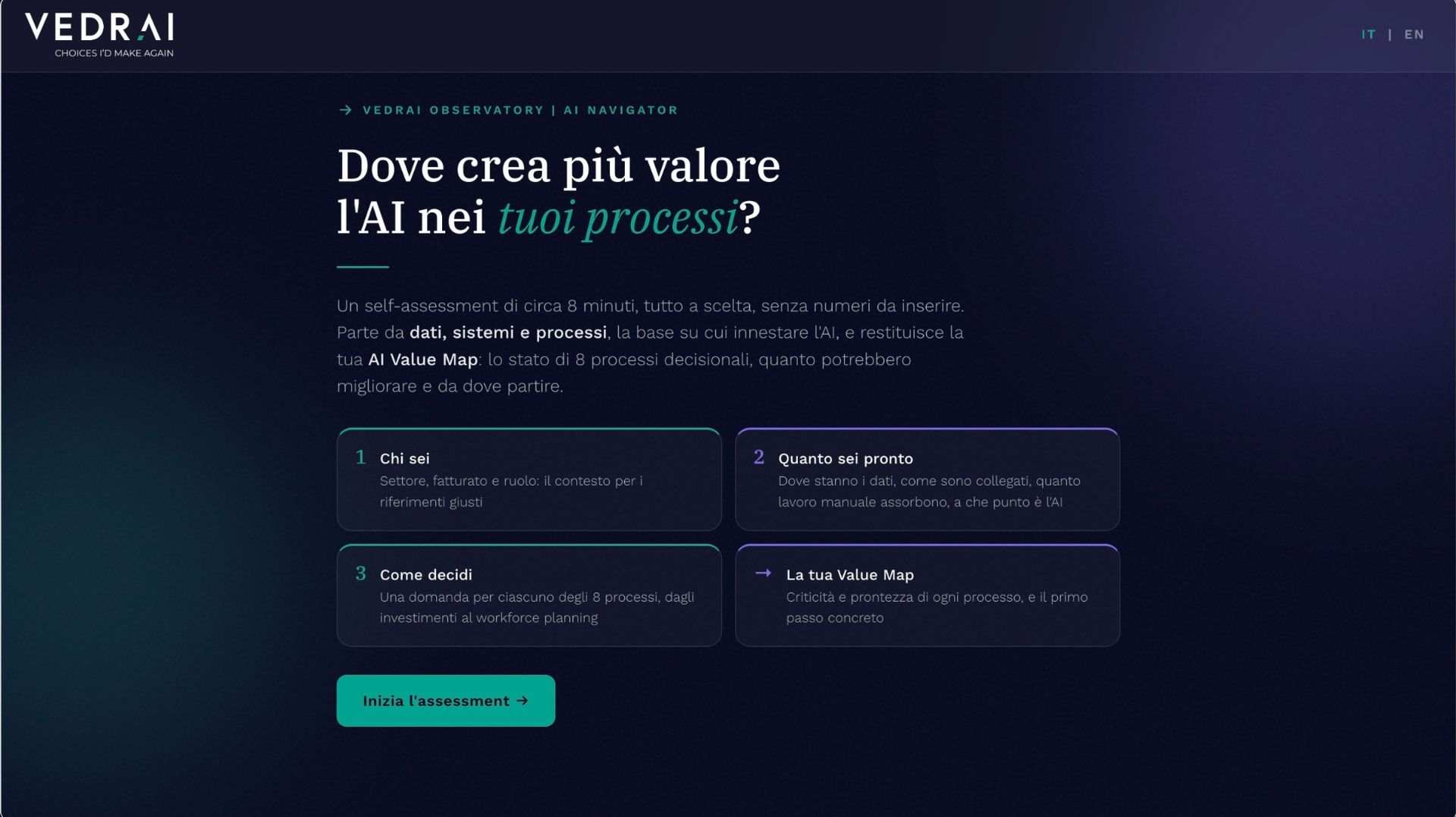
This is what Vedrai Observatory's AI Navigator is for: a self-assessment of about 8 minutes, all multiple choice, with no figures to enter. It starts from data, systems and processes, the base on which AI is built, and returns your AI Value Map: the state of 8 decision processes, how much they could improve and where to start. It has three steps:
- Who you are: sector, revenue and role, to set the right benchmarks.
- How ready you are: where the data sits, how it is connected, how much manual work it absorbs and where AI stands today.
- How you decide: one question for each of the 8 processes, from investments to workforce planning.
The result is a ranked list of processes, with the criticality and readiness of each and the first concrete step. Start the assessment and find out where AI could bring the most value to your company.
Key takeaways
- Adoption is widespread: nearly 9 in 10 companies use AI (McKinsey, 2026) and 71% of large Italian companies have a project (Politecnico di Milano Observatory, 2025). Waiting has a cost.
- Value is concentrated: 37% see a positive EBIT impact, about 6% get at least 5% of EBIT from AI.
- The gain starts at task level (about 80% less time according to Anthropic) and becomes margin only if the process changes.
- Return can be shown only if measured upfront: just 11% of large Italian companies monitor AI in a structured way.
- Choosing where to start takes a map of processes: the AI Navigator produces one in about 8 minutes.
Frequently asked questions
Why is introducing AI in business now inevitable?
Because AI has already entered ordinary spending: according to McKinsey (2026) nearly nine in ten companies use it and 60% expect to invest more. A company that does not introduce it does not stand still, but falls behind on time, cost and quality against competitors and suppliers that already have.
What is the return on investment of AI in business?
It depends on the process. According to McKinsey (2026), 37% of companies attribute at least some positive EBIT impact to AI and about 6% get at least 5% of EBIT from it. The most useful figure is internal: estimate upfront, on a key metric, how much the process can improve.
Which processes should you start with when adopting AI?
Start with repeated decisions that weigh on margin or cash, where data exists and is connected, and where a measurable indicator lets you compare before and after. A process with scattered data and a lot of manual work needs its foundations fixed first.
What is Vedrai's AI Navigator?
It is a self-assessment of about 8 minutes, with closed answers and no figures to enter. It starts from data, systems and processes and returns the AI Value Map: the state of 8 decision processes, how much they could improve and where to start. It opens at ai-navigator.vedrai.com.
Should Italian SMEs invest in AI?
The gap is already open: according to Politecnico di Milano's Observatory, 71% of large companies have an AI project against 8% of SMEs. For an SME with limited resources, choosing the first process well matters before multiplying tools.
Find where AI creates the most value in your company
Start the AI Navigator: in about 5 minutes you get your AI Value Map, with processes ranked by potential value and the first concrete step.