This article has been written with the support of artificial intelligence and reviewed by the Vedrai team, which manages the content in the Resources section of the website.
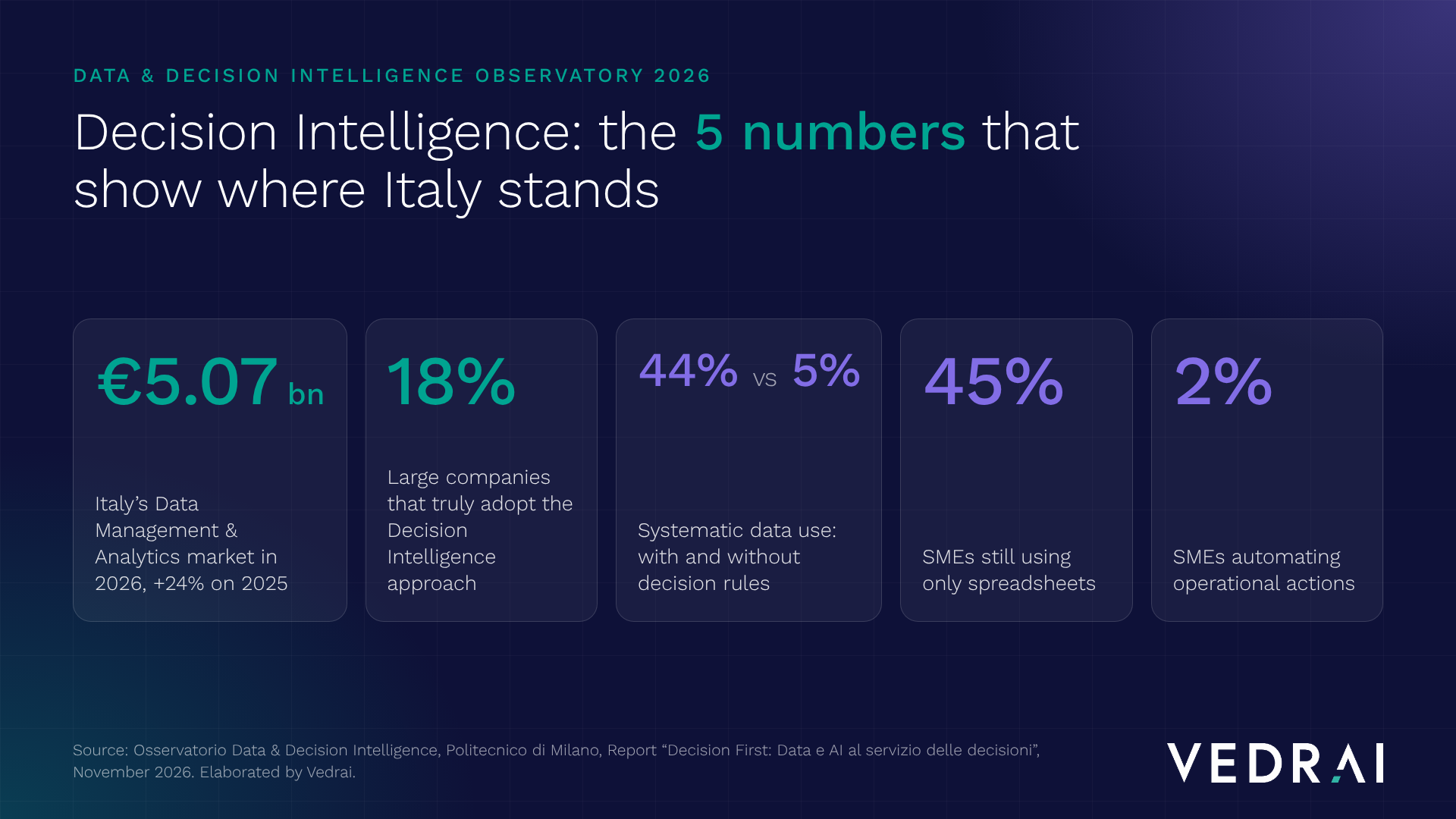
€5.07 billion: that is what Italy’s Data Management & Analytics market is worth in 2026, 24% more than last year. Yet only 18% of large companies truly adopt Decision Intelligence. It is not a data problem. It is a decision problem.
The Data & Decision Intelligence Observatory of the Politecnico di Milano measured this gap in its Report “Decision First: Data e AI al servizio delle decisioni” (November 2026), to which Vedrai contributed as a research Partner. To read it quickly, we picked five numbers: the market size, the share of large companies that truly adopt Decision Intelligence, the gap between companies with decision rules and those without, the share of SMEs stuck on spreadsheets and the share that reaches automation.
Together they tell one story: spending is racing ahead, while the ability to turn it into better decisions lags behind.
How big is the Data Management & Analytics market in Italy in 2026?
In 2026 spending by Italian organizations, public and private, on infrastructure, software and services to manage and analyze data reaches €5.07 billion, with expected growth of 24% on 2025. This is a preliminary estimate, to be finalized in 2027. After three steady years around 20%, the market is accelerating: in 2018 it was worth €1.39 billion, and today it is worth more than three and a half times as much.
Growth is led by Generative AI delivered as SaaS or through APIs: it still accounts for only 6% of spending, but grows 46%. Business Intelligence & Data Science rises 24% and Data Management & Architecture 20% (it was 13% in 2025), a sign that companies are investing again in the foundations that make AI usable. 87% of large organizations have already built Advanced Analytics or AI into their applications. These are the AI trends in companies in 2026 that we also see in the field.
The picture changes by sector: retail and large-scale distribution grow 40%, Manufacturing 32%, Services 30%. Manufacturing and banking each account for 27% of total spending, more than half together, and organizations with more than 249 employees generate 75% of the market. Spending, however, does not say how decisions are made. The other four numbers do.
How many large companies truly adopt Decision Intelligence?
The Observatory defines Decision Intelligence as the ability to design, run and improve decisions as if they were products, combining data, AI, decision science and human judgment across the whole life cycle. The approach is decision-first: the starting question is no longer which data is available, but which decision to improve and what would happen if some variables changed.
Many large organizations say they have Data Visualization, Generative AI, Embedded Analytics and Conversational BI tools, and about one in four has already adopted at least one Decision Intelligence platform. But only 18%, fewer than one in five, truly adopts the approach.
That 18% comes from the intersection of three levers: Advanced Analytics projects (78% of large and very large companies, up from 73% in 2025), a structured data ontology (31%) and mapping of decision processes (27%). The ontology is the shared model of business concepts, their definitions and the relationships between data. The first lever is widespread. The other two, which connect algorithms to decisions, are still rare.
[Image 2 to insert] File: vedrai-decision-intelligence-03-leve-decision-intelligence-grandi-imprese.png. Alt text: Horizontal bar chart: 78% Advanced Analytics projects, 31% data ontology, 27% decision process mapping, 18% all three levers. Caption: Source: Osservatorio Data & Decision Intelligence, Politecnico di Milano, Report “Decision First: Data e AI al servizio delle decisioni”, November 2026. Elaborated by Vedrai.
How much to entrust to AI also has to be chosen decision by decision. In support, the person decides starting from insights; in augmentation, solutions propose scenarios and alternatives and human judgment remains necessary for the final choice; in automation, the decision is made and executed by the system. Where decisions are critical and poorly standardized, the Observatory notes, support and augmentation prevail. Management control is the area with the most augmentation solutions (48% of companies with experiments under way), while HR is the one most tied to support (84%).
Why do decision rules and data quality change everything?
Governance is taking shape: 48% of large organizations have formalized a Data Strategy, 11 percentage points more than in 2025, and 57% of them have assigned responsibility for data to an executive-level role. The next step is to formalize decisions.
Today 44% of large organizations have identified their critical or high-impact decisions and apply decision rules built into their applications. 35% have identified recurring decisions without documenting them, and 21% still decide case by case. The first group has made explicit which decisions matter, who makes them and on what information.
The difference shows in how data is used. Among companies with decision rules, 44% use data systematically in decisions, against 5% of those without. 50% have extensively mapped their processes with dedicated KPIs, against 9%.
Data quality does the rest. Where it is high, 44% of business users analyze data on their own, against 17% with medium quality and 12% with low quality. 75% have implemented an ontology (10% where quality is low), 72% use a Data Catalog (20%) and 80% have introduced Generative AI solutions (40%). A generative model produces reliable results only if it can rely on governed data.
Where do Italian SMEs stand?
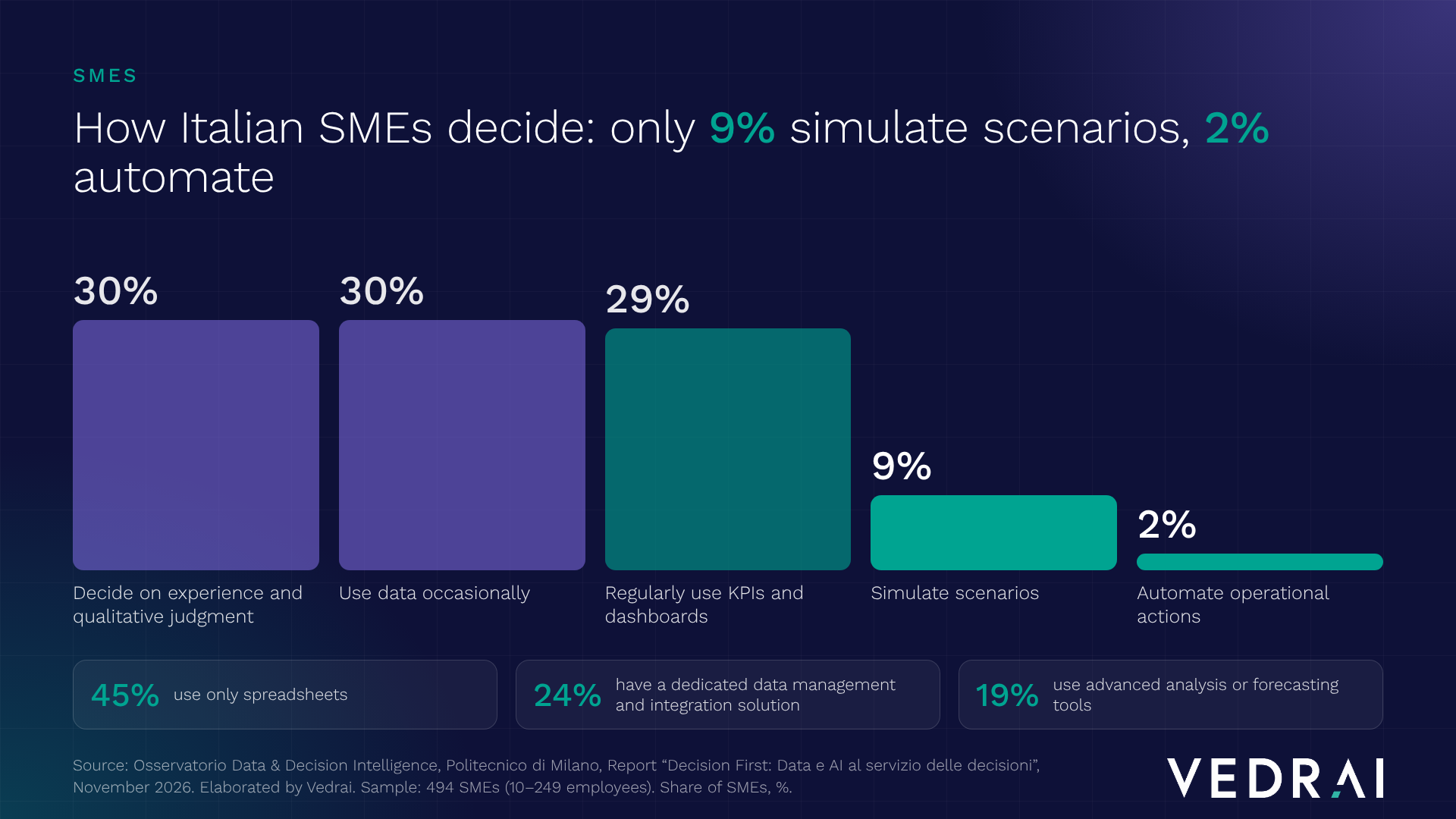
In 2026 29% of Italian SMEs say they regularly use data to monitor goals and performance, through KPIs and dashboards. The figure should be read together with the other maturity levels: 30% still decide mainly on experience or qualitative considerations, and a similar share uses data only occasionally, to give context to decisions.
The tools confirm the picture. 45% of SMEs use only spreadsheets for analysis and reporting, in line with 2025. 24% have a dedicated solution for managing and integrating company data (4 percentage points more than in 2025) and only 19% have advanced analysis or forecasting tools.
Structured use is concentrated where data measures the economics of the business: administration (73%), sales (61%) and management control (57%). Medium-sized companies are further ahead: 47% regularly use KPIs and dashboards and only 13% decide mainly on experience, against 27% and 32% of small companies. 29% of medium-sized companies have a formalized data strategy, against 14% of small ones.
Why do SMEs still decide almost without simulating?
Only 9% of SMEs use data to simulate scenarios in support of decision-makers, and just 2% automate operational actions based on analyses. The step from reporting to forecasting remains rare.
The Observatory describes a fragile organizational foundation. Data Analysts and Data Engineers are present in fewer than two SMEs in ten and are often not even sought: the constraint concerns, besides the availability of skills, the very perception of the need. In 31% of cases data is not used in a structured way in decisions and no one is responsible for it.
Those who use data and models do see the benefits. SMEs cite better traceability of choices and their rationale (34%) and fewer operational errors or inconsistencies (30%). Generative AI connected to company data is also present in 14% of SMEs, and more companies plan to adopt it in the next twelve months.
For an SME, the starting point can be a single decision that weighs on margin, with the ability to compare scenarios before choosing. You do not need to understand AI: you need to understand where it pays off.
Where does WhAI sit in Decision Intelligence?
These numbers show where the value of data stops: at the step from answer to decision. WhAI is the layer between your processes, your data and your decisions, and it works alongside the general-purpose LLMs a company already uses. It calculates scenarios on the KPI tree, brings the market into the model and makes choices, assumptions and outcomes traceable, because critical and complex decisions require a decision harness: the infrastructure that sits alongside the language model and constrains its use to a specific task. The person decides. Request a demo to see it on a real decision in your company.
Key takeaways
- Italy’s Data Management & Analytics market is worth €5.07 billion in 2026 (+24%), but only 18% of large companies truly adopt Decision Intelligence.
- Where decision rules exist, 44% of large companies use data systematically, against 5% of those without.
- 45% of SMEs use only spreadsheets: 9% simulate scenarios and 2% automate operational actions.
- Where data quality is high, 80% of large companies have introduced Generative AI on company data, against 40% of those with low quality.
Frequently asked questions
What is Decision Intelligence?
Decision Intelligence is the ability to design, run and improve decisions as if they were products, starting from the decision to improve rather than from the data available, and combining data, artificial intelligence, decision science and human judgment across the whole life cycle. It is the definition used by the Data & Decision Intelligence Observatory of the Politecnico di Milano.
How big is the Italian Data Management & Analytics market in 2026?
According to the Data & Decision Intelligence Observatory of the Politecnico di Milano, Italy’s Data Management & Analytics market is worth €5.07 billion in 2026, with expected growth of 24% on 2025 and a preliminary estimate to be finalized in 2027. Generative AI delivered as SaaS or through APIs accounts for 6% of spending and grows 46%.
How many large Italian companies adopt Decision Intelligence?
Only 18% of large and very large Italian companies truly adopt the Decision Intelligence approach, meaning they have Advanced Analytics projects, a structured data ontology and mapped decision processes together, according to the Data & Decision Intelligence Observatory of the Politecnico di Milano (2026). About one in four has already adopted at least one platform.
How do Italian SMEs use data in decisions?
In 2026, 29% of Italian SMEs regularly use data through KPIs and dashboards, 30% still decide mainly on experience and 45% use only spreadsheets for analysis and reporting, according to the Data & Decision Intelligence Observatory of the Politecnico di Milano. Only 9% simulate scenarios and 2% automate operational actions based on analyses.
Why do decision rules make a difference in how data is used?
Among large companies that have formalized critical decisions with rules built into their applications, 44% use data systematically in decisions, against 5% of those without decision rules, according to the Data & Decision Intelligence Observatory of the Politecnico di Milano (2026). Mapping of processes with KPIs is also more widespread: 50% against 9%.