
What is a decision intelligence platform?
A decision intelligence (DI) platform is software that supports, augments and automates business decisions by combining data, advanced analytics, domain knowledge and artificial intelligence. Unlike traditional business intelligence tools, which show you what happened, a decision intelligence platform answers the question "what should we decide now, and with what consequences?" by comparing alternative scenarios and making trade-offs explicit.
For a company, this means turning data scattered across ERPs, management systems and spreadsheets into traceable, governed and simulatable decisions on high-impact topics: pricing, investments, production planning, supplier management and resource allocation.
Why isn't adopting AI enough? The value paradox
The real challenge for companies today isn't adopting AI, it's turning it into value. According to market data, 72% of companies say they have adopted AI, but only 12% get measurable, concrete value from it (PwC Global AI Jobs Barometer 2025; McKinsey State of AI 2025).
The gap isn't technological, it's methodological. Generative AI speeds up analysis and produces fast recommendations, but on its own it doesn't structure fragmented data, doesn't validate information, and produces output that is coherent in form but unverifiable in substance. For management, the risk is turning intuition into automation and hard-coding bias, exposing the business to systemic decision errors.
A decision intelligence platform closes exactly this gap: it provides the method, made of certified data, deterministic calculations and governance, that turns AI adoption into reliable decisions.
How is decision intelligence different from business intelligence?
The difference lies in where the data ends up. Business intelligence stops at the dashboard and the report: it captures the situation and leaves interpretation and decision-making to the user. Decision intelligence starts there and goes further, connecting data to a model of the decision itself: which levers can I pull, what constraints do I face, which external factors matter, and which scenario best achieves the business goal.
Gartner has formalized this distinction by recognizing decision intelligence platforms as a standalone market category, defining them as software that "supports, automates and augments decision making of humans or machines through the composition of data, analytics, knowledge and AI techniques."
In practice, the market is shifting from a data-driven approach (collecting and visualizing data) to a decision-centric one (using data to decide better and faster).
Why aren't LLMs alone enough to decide? AI as an orchestrator, not an oracle
A language model (LLM) used as an "oracle", asked directly "tell me what to do", is fragile and sensitive to how the question is framed. In tests, the same decision question (evaluating an investment) reworded differently, or run on a different model, can lead the AI to completely reverse its recommendation: from "go ahead" to "don't proceed." For critical decisions, this variability is unacceptable.
Decision intelligence takes the opposite paradigm: AI as an orchestrator, not an oracle. Data comes from certified, verifiable sources, calculations are deterministic and separate from the LLM, and the AI only orchestrates the information flow, while the manager decides on solid ground. Structuring the decision flow this way can deliver a significant improvement in accuracy compared with using the LLM directly.
Once again, the paradigm shift isn't technological, it's methodological.
How does AI-driven scenario analysis work?
Scenario analysis is the operational core of a decision intelligence platform. It works in four steps:
- Decision modeling. Define the variables that matter (prices, volumes, costs, production capacity) and the relationships between them.
- Data and external-factor integration. The platform connects internal data (ERP, CRM, management systems) and incorporates up-to-date, certified market, sector and macroeconomic variables.
- Scenario simulation (what-if and stress tests). AI generates and compares alternative scenarios ("what happens if I raise prices by 5% and demand drops 3%?"), varying multiple factors at once and testing extreme conditions.
- Traceable recommendation. Each scenario is documented and comparable, so the final choice rests on explicit reasoning rather than intuition.
The benefit for the decision-maker is twofold: speed (scenarios are generated in minutes, not weeks) and transparency (every recommendation is explainable and auditable).
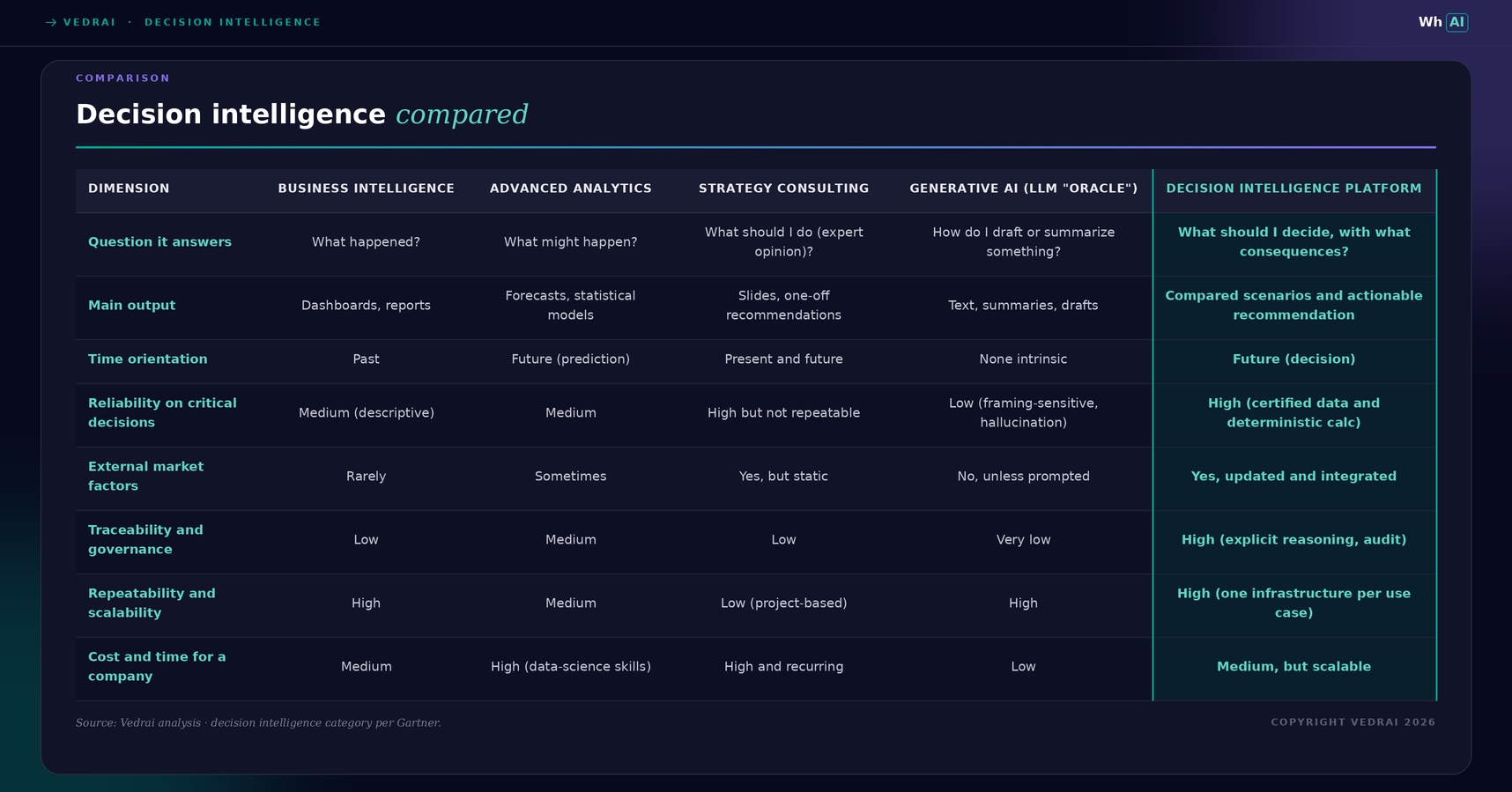
Decision intelligence vs BI, advanced analytics, consulting and generative AI: what's the difference?
These are five different approaches to the problem of "how do I use data to decide". The table below compares them on the dimensions that matter for a company.
What are the pillars of AI adoption that actually creates value?
Technology alone isn't enough. Turning AI into sustainable value requires four pillars that a decision intelligence platform must cover:
- Data. Structured, accessible, high-quality data. It's the ground everything rests on: without reliable data, any AI system is built on unstable foundations.
- Tech. Not a generic LLM, but a technology system integrated into existing business processes. Technology serves the process, not the other way around.
- Method. Defined KPIs, clear processes, systematic measurement. AI isn't magic, it's engineering, and it takes rigor to make value repeatable.
- People. People at the center. AI amplifies, it doesn't replace: the manager decides, the AI informs. Without skill transfer and change management, the technology goes unused.
What should a company evaluate when choosing a SaaS decision intelligence platform?
Before adopting a decision intelligence tool, a company should evaluate seven criteria:
- Integration with existing systems. It must connect to ERPs, CRMs and files already in use without long, costly IT projects.
- Time-to-value. How fast do you get the first useful insights? Modern SaaS solutions create value as early as the data-connection phase.
- Governance and reliability. Certified data, verifiable calculations and orchestrated AI: the platform must ensure consistency and reduce bias and variability.
- Custom scenario modeling. It must let you define your business-specific variables, not just rigid templates.
- External-factor integration. The best decisions account for market, sector and macroeconomic context in real time.
- Scalability and no lock-in. Every new use case should build on the same infrastructure, with data and models compatible with any AI solution.
- Access model and support. Guided setup matters, as does the ability to access the platform directly, through your own LLM, or as a managed service, without needing an in-house data-science team.
Where does Vedrai's WhAI fit in?
WhAI is Vedrai's decision intelligence platform: the operating system for using AI in your company in a reliable, governed way. It orchestrates the four pillars, data, technology, method and people, to make AI dependable in decision processes, in three steps. It structures the entire decision system (certified internal and external data, shared KPIs and taxonomies, deterministic models); it orchestrates AI within business processes (coordinating agents and workflows, using LLMs as an orchestration layer via MCP); and it makes decisions reliable and governed (verifiable output, reduced bias and variability, audit and compliance).
The journey is modular and starts from where the company is today: from governed AI adoption to performance analysis, from process optimization (pricing, production, procurement, logistics) to strategic planning with what-if scenarios and stress tests. Application areas span Strategy, Finance, HR, Sales, Marketing, Procurement and Supply Chain, Operations and Production, and WhAI is available in three modes: directly on the platform, through your preferred LLM, or as a managed service with an AI Strategist embedded in your processes.
Expected benefits, based on market benchmarks and WhAI use cases, indicate a 20-40% reduction in ex-ante decision risk, a 30-50% reduction in time from analysis to decision, and 100% internal decision governance, meaning a shared, consistent decision language across functions, levels and objectives.
WhAI is built for companies that have structured data and want to improve their processes and decisions with a more rigorous, data-driven approach.
Key takeaways
- The AI paradox: 72% of companies adopt AI, but only 12% get measurable value. The gap is methodological, not technological.
- A decision intelligence platform combines data, analytics, knowledge and AI to support, augment and automate decisions.
- Unlike business intelligence, it doesn't stop at describing the past, it guides the future decision by comparing scenarios.
- Use AI as an orchestrator, not an oracle: certified data and deterministic calculations make decisions reliable; an LLM alone is framing-sensitive.
- The four pillars of value-creating adoption are Data, Tech, Method and People.
- Vedrai's WhAI is a SaaS decision intelligence platform, a decision-governance operating system, built for companies.
Frequently Asked Questions (FAQ)
What is decision intelligence in simple terms? It's the combined use of data and artificial intelligence to decide better: instead of just showing data, decision intelligence compares the possible options and suggests the one with the best expected outcome, and explains why.
Why isn't using ChatGPT or an LLM enough to make business decisions? Because an LLM used as an "oracle" is sensitive to how the question is framed: changing the wording or the model can flip its recommendation. A decision intelligence platform uses AI as an orchestrator, with certified data and deterministic calculations, making decisions reliable and verifiable.
Does decision intelligence replace business intelligence? No. Business intelligence remains useful for monitoring and describing business performance, and often feeds its data into the decision intelligence platform. DI adds the decision layer that BI doesn't cover.
Do you need a team of data scientists to use a decision intelligence platform? Not necessarily. Modern SaaS platforms like WhAI translate technical complexity into tools accessible to any manager, with guided setup and expert support, so even companies without an in-house data-science team can adopt them.
How long does it take to get the first supported decisions? The first insights emerge as early as the data-connection phase: you don't have to wait for advanced models to create value. Models and simulations then refine progressively over time.
Is decision intelligence suitable for all companies? It suits any company that has structured data (in systems or files) and is open to a more structured, data-driven approach to decision-making.